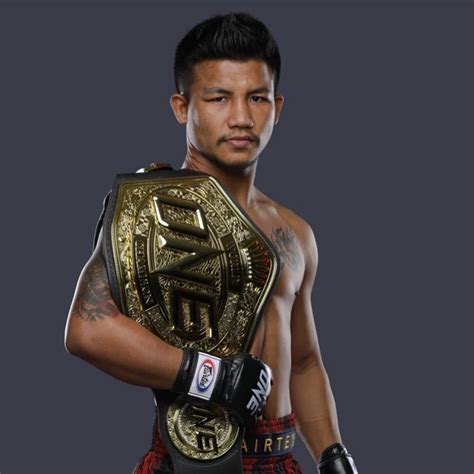
Choosing a gym in Thailand can be an overwhelming undertaking, and so it is important to have the opportunity to read an unbiased review of each camp you may be considering. This article is an updated gym review of Kem Muaythai Gym. The first review was written in 2017 by Angela Chang, and this updated one is written by Megan McNelis, who has spent several months there to date. Much about the gym has changed, so this update was long overdue.
I regret to inform you that this is not that unbiased review (although I have done my best to do so!). It has been four months now. I haven’t left, nor do I plan to. So while I will be as accurate as possible in telling you my experience, I have to warn you that I’m smitten. I’ve got it bad for Kem Muay Thai.
Disclaimers: When quoting Thai people speaking English, the author (Megan) writes similarly to how the sentences are spoken to her. This is for accuracy and to lend to the narrative voice and is in no way meant to undermine the importance of their words. Although quite a bit has changed since the first review, the author has tried not to repeat too much information already given.
Guess Who’s Still Here?
“I was gonna be here a month, but I’m honestly sick of Bangkok,” said Flynn, a friendly Londoner I’d met at my two-day stint at Superbon Training Camp. We were both 33 years old and had hit it off during partner drills one morning (we probably bonded over our mutual joint pain).
At this point, I had been at Kem Muay Thai for about half of my planned one-month stay before heading up to Manop Gym in Chiang Mai. On a whim, I suggested he leave Bangkok little early and come try it out, suggesting he’d prefer the quiet mountain air to the traffic and heat of the city. To my delight, my new friend agreed. “I’ll come up there for a week.” The week passed. Flynn didn’t leave. Another month passed. I didn’t leave.
Read also: The Significance of the Mongkol
I wasn’t in Chiang Mai; I was on top of a rented stepladder at 11pm on a Thursday, cheering Flynn on (and trying not to flail my arms too much, at the risk of accidentally making a bet) as he stepped into the ring for the first time.
The Camp
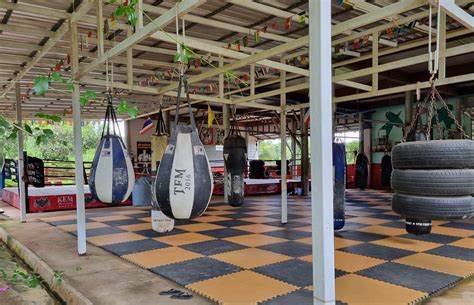
“Mali is very sweet,” I said as a newcomer scratched the friendly, annoyingly vocal piebald cat behind the ears. “Do not let her in your room. She’ll pee on your bed.” The lore was passed to me, and it is now my solemn duty to pass it to the students who come after me. Mali and the camp dogs, Nike and Dtom Soup, like visiting us in the treehouse-like dining area, which overlooks the camp and gives sweeping views of the beautiful mountain valley.
Meals are served here twice a day. They’re almost always home-cooked by P’Mo (Kem’s wife and co-owner) and are always delicious. I can’t come up with an answer when people ask me what food I miss from home because we are so well-fed at camp. Most Thai food, while delicious, is quite high in fat, carbs, and sodium and low in fiber. While we do usually eat Thai food, P’Mo makes sure to add more vegetables than usual and will modify recipes to account for students’ allergies, preferences, and tolerance for spiciness.
Each student is given their own plate. You can ask for a smaller portion of rice. You can ask for boiled eggs. You can ask for seconds. P’Mo will do anything to make you happy and remembers how every single student likes their coffee and tea.
Many students like to hang out in the “treehouse” outside of meal times to read, craft, and socialize. Otherwise, we’re usually in our private bungalows (or, when the camp’s bungalows are full, a room provided at one of the inns next to the camp).
Read also: Authentic Muay Thai Training
No two bungalows are exactly alike, but all are equipped with a bed, linens, a desk, a chair, a wardrobe, and a fridge. Every room has hot water and air conditioning. P’Kem and P’Mo have added four newer Bungalows in recent years and are continuing to expand. These rooms are cozy, not overly fancy, and occasionally come with many-legged “guests,” water shut-offs, and other remote jungle village problems that are beyond the camp’s control. When you aren’t in a tourist area, this is what life looks like sometimes.
The camp provides free drinking water and free laundry machines. There is a working steam sauna on site, and you can request ice if you’d like to have an ice bath. Sometimes, P’Mo buys electrolyte powder for all of the students, and she has told me she’s thinking of providing multivitamins to the fighters who have upcoming bouts on the bigger promotions. “Want you strong!”
Van trips into Pak Chong occur every Sunday, as well as other occasional excursions. They ask 200 baht to help with gas; 12 people in a van going up and down a steep hill uses a lot of fuel!
Training
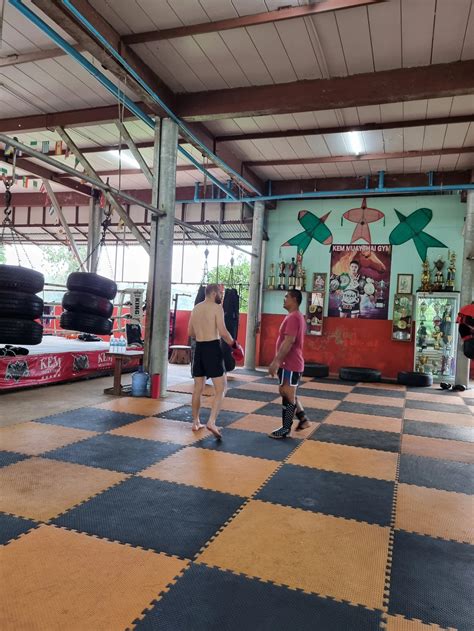
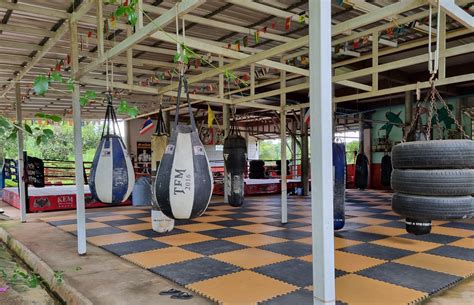
“It used to be harder,” joked Sarkis, one of the camp’s veteran students. The biggest change in the camp from when Angela wrote her article in 2017 is that the camp (while still absolutely a “fighter’s camp”) has adapted beautifully to its changing client base post-COVID.
Kem Muay Thai used to have a handful of students at any given time. Now, there can be over 20 (they have discussed a cap). Almost all of the students at Kem are non-Thai and stay for short stints. While most are serious students, many are not experienced fighters. Kem has done an impeccable job in managing the training to be adaptable for newcomers while remaining effective and challenging for those with experience.
Read also: Choosing a Muay Thai Gear Bag
Likewise, P’Kem and the other trainers encourage students to be vocal when dealing with fatigue or injuries so that they may adjust their instructions accordingly. While he comes from a harder, more “old school” era of training, Kem will never ask an injured student to train through an injury. He’s quite the opposite: on more than one occasion, he has saved me from myself, telling me to “jai yen” (cool your heart) and go shadowbox and stretch when I attempted to push through.
P’Kem trusts us to manage our own running. with three rounds of shadowboxing, one round with 2kg weights. This is generally followed by pads (4×4 minute rounds) and three rounds of boxing (first round: speed punching for two minutes + jab-cross-hook for two minutes. Second round: a full round of alternating speed/power jab-cross’. Third round: a 4-minute round of cross-hook-cross.)
Form is heavily emphasized. After, you will do either freestyle bag work or a simple assigned combination (usually push kick + knee). We finish off with 2 full rounds of elbows and 30 push-ups.
P’Kem, worried that some of the students will feel under-stimulated, will occasionally remind us that the training is the same every day because he wants us to build the muscle memory to keep us safe and strike effectively even when we are tired in the later rounds. The thing that sold me the most on P’Kem is the attention he pays to each and every student, even when the gym is packed. This is not a “hit the bag until you get called for a few pad rounds,” gym. In the first week, you will likely spar and hit pads with Kem himself. He literally studies you and determines your level, strengths, and weaknesses.
Not only does he check in and give pointers while you spar, do your bag work, and hit pads - I have heard him inform the trainers/pad holders how he wants them to hold for me specifically.
Kem genuinely cares, is heavily involved in every single session, and is constantly adapting the training regimen to suit the needs of the group. Once, during a ride into town, he asked me where I had trained previously, what was different, and what I liked about that gym that he could consider incorporating into his program. To be honest) this is the only place I’ve been asked such a question. Kem is a coach because he loves it; not because he doesn’t have other options.
Please support the continuation of content on Muay Ying via Patreon
Fighting
“Kem want safety first,” says P’Kem, as he makes us hold a check while hopping on our standing leg for a solid minute. “One minute, and change. Kem no happy? Two minute.” He grins. Defense and fighting smart are two of P’Kem’s top priorities. If you’re not a great fighter but have heart, he will still find you an opportunity… but only once he’s confident that you won’t be truly hurt.
I snapped a few black-and-white shots to test my camera lenses backstage at Rajadamnern Knockout. Kem was demonstrating defensive techniques he wanted my two teammates, Alex and Viktor, to utilize during their fights. Viktor is an accomplished professional who had dreamed of fighting on this stage for years, while Alex was making his Raja debut after just two local fights in Isaan. Kem had assessed that both of them were more than ready for this test.
He tells me I can fight here too. “But not yet. Step by step. You can fight Raja now. Win, no win, Kem no care; Kem want safety. But Kem want you win; Kem want you happy.”
Kem will never ask for a cut of your fight purse when you come to this stage (which is the proper thing to do for paying customers) but he also doesn’t expect a tip (which is customary). You have to earn your way to Bangkok by demonstrating progression in the local circuits.
For these local fights (and I understand that this part is controversial) you will not be paid. Initially, this bothered me, and after establishing a good rapport at the gym, I asked one of Kem’s disciples why this was. As I suspected, P’Kem does not pocket a cent of the fighter’s purse. There are three main reasons why we don’t receive the (usually less than 1000 baht) fight purse:
- Kem wants his students to have as many opportunities as possible, and due to local fighters’ hesitancy to fight “farang” and tendency to back out of fights, Kem began working with promoters to increase the fight purse of local Thai fighters.
- The purse is donated to the wat (temple) where many of these fights are held.
- Kem pays the spectator fees for the students who come to support the fighters.
I personally feel that this is an appropriate price to pay for what, to me, feels like giving back to the Isaan Muay Thai community. For me, fighting is a choice, a passion, and a privilege. I’m lucky to be guided by Thai mentors and allowed to grow by fighting with Thai locals.
Safety for Women
I would be remiss not to discuss safety in terms of how the camp is for women fighters. Muay Thai is a hands-on sport, and in Thailand, it is very common for trainers to engage in a lot of “physical comedy” and provocative touch with the male students, up to and including what most of us would deem highly inappropriate (butts/genitals).
Many of these trainers are not overly used to working with female students, especially ones who come from Western countries and may dress far less conservatively than Thai women. Let me be clear: this does not make it okay for any trainer to touch you in a way that makes you uncomfortable.
As with other camps, the trainers at Kem Muay Thai cycle in and out. Fortunately, all of the more permanent trainers and pad holders have been very respectful, usually opting to simply not touch/engage in roughhousing with female students unless a very specific and safe rapport is established. But even then, this does NOT extend to the more inappropriate levels of touch to which some of the male students are subjected.
On one occasion, however, one of the trainers newer to the camp kept touching me at an event. Fortunately, P’Mo was standing near me at the time, and immediately shut down the behavior and asked if I was okay. I told her that I was fine, and said as tactfully as I could that while I didn’t like it, I was not overly offended because of being used to Thai culture. “However,” I added in Thai, “this can’t be allowed to happen. Most of Kem’s students are foreign, and will be very uncomfortable, and this will hurt the gym’s reputation.”
P’Mo agreed and asked me to report to her immediately if something like this happened again.
I’d like to add that if you are a male student at the camp and do not appreciate this kind of touch, I sincerely believe that the trainers here will back off if you tell them “mai ao krap” (here, roughly translating to a polite “no thank you/I won’t receive that.” Thai culture is so “high context” and generally non-confrontational; many Thai people are very good at reading intent, and they should not be offended or form a judgment about you for stating that preference.
The Cycle of Heartbreak and Farewells
Viktor knocked out his opponent that night, and Alex, who had been there since I’d arrived, won via a dominant decision. Once I released Alex from my boa-constrictor-like hug and turned away from him, I caught P’Mo’s eyes, which reddened despite her smile. I asked if she was tired. She shook her head.
“When I tired, I think of you fighters. You inspire P’Mo, because you training every day. You leave your homes, family, save money, to come here to fight.”
I suddenly remembered then that this was Viktor’s last day in Thailand and Alex’s last day with Kem before he headed up to Chiang Mai for his last two weeks in Thailand. That’s why P’Mo was getting misty-eyed. “I don’t like this part. Don’t like say goodbye,” she said. “Mo used to say to P’Kem, heart break every week.” It was P’Mo’s turn for a big hug now.
But you know what? The real goodbyes don’t actually happen very often. See, Alex was only supposed to be at Kem’s for one month, too. He was here for four. And when we came back to Bangkok the next week to support another pair of fighters, guess who was waiting for us at Rajadamnern? Alex never went to Chiang Mai. And the next day, he met me at Mochit to hop a bus back to Khao Yai Thiang. Back to Kem Muay Thai.
Summary
- Location: Khao Yai-Thiang, Khlong Pai Subdistrict, Sikhio District, Korat, Nakhon Ratchasima
- Proximity/Convenience to other things: Being about a half-hour drive up a mountain, it’s not easy to get anywhere else off the mountain once you’re at the camp. Exiting the road of the camp onto the main road, there is a small convenience store and a few food stalls up the road. Halal food is readily available as there is a sizable Muslim community in this village. There is not much “to do” besides enjoy being in nature, which is perfect for anyone who takes their training seriously and does not want distractions. The gym goes on occasional excursions to nearby attractions (especially if P’Kem senses people are tired/restless) and are very helpful if you need to make a special trip into town for medical treatment. The closest larger town is Pak Chong, not Sikhio. Grab is available from Pak Chong to the gym-it usually is not available from Khlong Phai or from the gym.
- Price (includes training, accommodation, and meals): For updated pricing and to book your stay, visit Kem Muaythai Gym. For a faster response, you can find them on Instagram. P’Mo runs the show, so please allow a little time for a reply.
Training: Morning run starts at 7:00 am, training starts after that. The biggest change in the camp from when Angela wrote her article in 2017 is that the camp (while still absolutely a “fighter’s camp”) has adapted beautifully to its changing client base post-COVID.
Kem Muay Thai used to have a handful of students at any given time. Now, there can be over 20 (they have discussed a cap). Almost all of the students at Kem are non-Thai and stay for short stints. While most are serious students, many are not experienced fighters. Kem has done an impeccable job in managing the training to be adaptable for newcomers while remaining effective and challenging for those with experience.
KEM MUAYTHAI GYM : Real muay thai With a world champion and world class coaches : 090-289-6416