Muay Thai, often called the "Art of Eight Limbs," is a martial discipline with deep historical roots in Thailand. Muay Thai or Thai Boxing is the national sport and cultural martial art of Thailand. The word muay means “boxing”, leading to a direct translation of muaythai (also sometimes written as two words, Muay Thai) as “Thai boxing”.
The name “Art of Eight Limbs” refers to the combined use of fists, elbows, knees and shins. Muay Thai is referred to as “The Art of Eight Limbs”; and using eight points of contact the body mimics weapons of war.
But what is muaythai? What is the history of the sport and how often are international competitions held? What are the muaythai rules? This article delves into the origins, evolution, techniques, and regulations of this dynamic combat sport.
Origins and Evolution of Muay Thai
Initially crafted for warfare, it evolved from Krabi Krabong, an ancient system of unarmed combat. It evolved from Krabi Krabong, literally long and short weapons, the weapons tactics of the Thai army. This fighting style enabled warriors to utilize fists, feet, elbows, and knees as weapons. Muay Thai’s history is intimately linked to the rise of the Thai nation.
The distinctive style that is Muay Thai is thought to have developed over centuries as the major tribes of that era (one of which was the Siamese) migrated through China, Vietnam, Laos, Burma and Cambodia.
Read also: The Significance of the Mongkol
The early Muay Thai bouts pitted different companies within the Siamese army against each other in unarmed combat (Muay Boran) with few rules and no weight divisions or time limits. It served not only as a battlefield tool but also as a method for developing strength and courage among soldiers.
Over time, as it transitioned from military application to a regulated sport, the introduction of boxing gloves helped protect fighters and formalize matches. The development of Muay Thai spans several important periods-Sukhothai, Ayutthaya, Thonburi, Rattanakosin, and its modern form-showcasing its progression from an essential combat skill to Thailand’s national sport.
Here’s a look at the historical timeline:
- Ayutthaya Period (1350-1767) - Muay Thai gained royal patronage, and fighters were recruited to guard the king and royal family.
- Early 20th Century - Modernization of Muay Thai began with the introduction of boxing rings, timed rounds, and the use of gloves.
- World War II Era - Muay Thai gained international exposure as Thai soldiers demonstrated the art to foreign allies.
The Siamese army was created to protect the government and its inhabitants within the city and surrounding villages. Soldiers were taught hand-to-hand combat and how to use weapons, as well as how to use the entire body as a weapon. Learning the military arts or “Muay Thai” became engrained in the culture of the early Siamese people.
During the Sukhothai era, Muay Thai was considered a high-level martial art and part of the royal curriculum. Kings were trained in Muay Thai to enhance their physical strength and combat skills. Historical records mention King Sri Intradit sending his son, Prince Ruang, to train in Muay Thai at the Khao Samorkorn martial school, known as the origin of Muay Lopburi.
Read also: Authentic Muay Thai Training
The Ayutthaya era (1350-1767 AD) was a defining period for Muay Boran, as the kingdom was often at war with its neighbors. King Naresuan, a strong advocate of Muay Boran, ensured his soldiers were well-trained in both armed and unarmed combat. Muay Boran also flourished outside military circles, gaining popularity as a form of entertainment.
One of the most famous figures from this era is Phra Chao Suea (the Tiger King). Known for his exceptional fighting abilities, he often disguised himself as a commoner to participate in local boxing matches, demonstrating his mastery of Muay Boran. His contributions to the art are significant, as historical records from the reign of King Rama V reveal that Phra Chao Suea developed his own set of signature moves, known as "Tamra Mae Mai Muay Thai Tamrab Phra Chao Suea" (Muay Thai of the Tiger King).
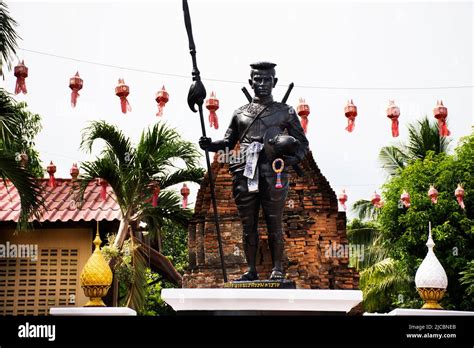
Statue of King Naresuan the Great at Naresuan University
During the 14-year reign of the Thonburi Kingdom (1767-1782 AD), Muay Boran played a critical role in military training and warfare. After King Taksin the Great restored Thailand’s independence, the kingdom needed to rebuild its military strength to defend against future threats.
The Rattanakosin era, beginning in 1782, marks the transformation of Muay Thai from an essential military skill into Thailand’s national sport. King Rama I was a significant supporter of Muay Thai, having trained in the art from a young age.
Read also: Choosing a Muay Thai Gear Bag
Modern boxing gloves replaced traditional Kard Chuek, and standardized weight divisions were introduced, enhancing safety and fairness. The construction of stadiums such as the Lak Muang Stadium in Tha Chang also laid the groundwork for the modern sport we see today.
Under King Rama IX (1946-2016), Muay Thai grew into a global phenomenon. The iconic Rajadamnern Stadium, which opened in 1945, and Lumpinee Stadium in 1956, became the epicenters of Muay Thai. Weekly fights broadcast across the nation helped popularize the sport further.

Lumpinee Boxing Stadium in Bangkok
In 1999, the Thai government enacted the Boxing Sports Act, which created the Board of Boxing Sport under the Sports Authority of Thailand. This act provides legal authority to regulate, promote, and protect Muay Thai as a professional sport. The Board of Boxing Sport is responsible for overseeing the conduct of matches, ensuring fighter safety, and preserving the integrity of Muay Thai in line with national and international regulations.
Muay Thai Techniques
Muay Thai’s distinction as the "Art of Eight Limbs" stems from its use of eight contact points: fists, elbows, knees, and shins. This allows fighters to strike from various ranges and angles, making it a highly versatile martial art. To become adept in Muay Thai requires constant practise, drilling the techniques over and over until they form part of muscle memory.
Muay Thai techniques can be generally classed into attack, defense, and counter technique. Muay Thai training begins with learning the basic stance and movement. With the chin tucked in, the body is kept upright and hands in guard position to protect the head, and feet are kept roughly shoulder-width apart. Right-handers keep their left foot a little to the front while keeping their right feet roughly 45 degrees to the outside. Left-handers (Southpaws) do it in reverse with their right foot in front.
This posture allows the fighter to be in balance and ready to strike or defend when appropriate. Attacking techniques consist of punches, elbow strikes, knee strikes, kicks, push kicks and clinches. Defense techniques consist of blocks, lean backs, deflections, leg catches and dodges. These techniques mix and match to combine into combinations(combo) that can be used for attack or counter.
Each attacking technique includes a series of variations. Here Is A Look At The Various Attacking Technique And Variations:
- Punches: Punches are the most commonly used weapons in Muay Thai. The main punch techniques include the straight lead punch (jab), straight rear punch (cross), uppercut, hook, overhead punch, and spinning back fist. Punching power is generated with speed from the feet up, through shifting of weight, and rotation of the hip and shoulders.
- Elbow: The elbow is one of the hardest parts of the human body, making them an effective weapon in Muay Thai. There are many different ways to throw an elbow: sideways to the head, from the top down, reverse to the chin, flying elbow from the top down and spinning back elbow. When executed properly, elbow strikes can knock out an opponent or inflict deep cuts that can end fights via stoppages.
- Kick: The Muay Thai kick is a devastating weapon delivered via the shins. The kick is delivered from the outside, with the arm swung backwards along with the inside rotation of the hip to generate force. Kicks can be thrown to the opponent’s legs (known as low kick or leg kick), body, arms, the back or the head.
Beside the standard roundhouse side kick, Muay Thai kicks can be delivered in a variety of ways such as jumping kick, spinning back kick, axe kicks (top down with heel landing on opponent’s head), and the acrobatic cartwheel kick as popularized by Muay Thai legend, Saenchai.
- Knee: Knees in Muay Thai are typically close range weapons used during clinching. They are often thrown to the body, especially the ribcage but also on thighs and directly to the head. Jumping knee strikes can also be devastating if landed. When used effectively like other weapons of Muay Thai, knees can end fights by knockouts.
Knees are thrown with the rear leg to generate more force. They can be thrown straight or diagonally with clinching to keep the opponent within striking distance. They can also be delivered to the opponent’s head by jumping.
- Teep: The push kick, referred to as “teep” in Muay Thai, can be used as both defensively or offensively. It can be used as a technique to keep opponents at a distance and disrupting an advance or as a strike if delivered with power and accuracy.
There are a few ways to use the teep including the straightforward front push kick which can be delivered to the solar plexus, the lead leg, or even the face as a show of dominance. Teeps can also be thrown as a side kick with the rear leg, or jumping front kick for even more power.
- Clinch: Clinching in Muay Thai is a grappling technique usually used in combination with knee and elbow strikes. Clinching is a close range fighting style that requires many years of practice to master. Takedowns, or tripping the opponent to the ground are also allowed and performed during clinching. When used to the right effect, clinching can help fighters outscore their opponents and win fights.
Muay Thai Rules and Scoring
Muay Thai has several rules that govern the sport. These rules are in place to ensure the safety of fighters and promote fair play. In Muay Thai, bouts are typically scored on a 10-point system, similar to other combat sports such as boxing. The fighters are awarded points based on the effectiveness of their strikes, the number of strikes landed, and their overall ring control and aggression.
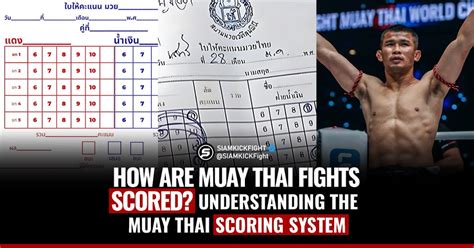
Muay Thai Scoring System
Muay Thai scoring is based on several criteria, and each judge scores the fight on a 10-point scale, where the winner of the round receives 10 points, and the loser receives 9 points or less. In cases where a fighter dominates the round or lands a knockdown, they may be awarded 10-8. The fighter with the most points at the end of the bout is declared the winner.
Effective striking: Judges look for strikes that land cleanly and with force. Strikes that are blocked or glancing are typically not scored as highly.
In addition to the effectiveness of the strikes, judges also consider the volume of strikes thrown by each fighter.
Judges also look for fighters who control the pace and position of the fight.
In addition to these factors, judges also consider factors such as knockdowns, clinching, and sweeping. It is also important to note that judges may have slightly different interpretations of the scoring criteria, and scoring can vary slightly depending on the ruleset and level of the competition.
Here is a table summarizing the scoring criteria:
| Criteria | Description |
|---|---|
| Effective Striking | Clean and powerful strikes that visibly impact the opponent. |
| Effective Aggression | Fighters who actively control the pace of the fight and demonstrate offensive skills. |
| Ring Control | Dominating the center of the ring and dictating the fight’s direction. |
| Knockdowns | Landing strikes that cause the opponent to fall or become significantly unbalanced. |
| Clinching | Effective use of clinching techniques to control the opponent and deliver strikes. |
Training and Conditioning
Training and conditioning are both very important in Muay Thai, focusing on developing physical strength, endurance, technique, and mental toughness. Muay Thai training is a rigorous and challenging process that requires discipline, dedication, and hard work.
The training process typically begins with learning the basics of Muay Thai, including footwork, strikes, and defensive techniques. This involves practicing movements and techniques repeatedly until they become second nature. As the practitioner progresses, they will typically move on to more advanced techniques, including combinations, clinching, and sparring. Sparring is also an essential part of Muay Thai training, as it allows practitioners to practice their techniques against a live opponent.
In addition to physical training, many Muay Thai practitioners also incorporate mental training into their practice. Muay Thai training can take place in a variety of settings, including traditional training camps, specialized Muay Thai gyms, and even in personal training sessions with a qualified instructor.
Here are some common training methods:
- Pad Work - Training with a partner or coach using pads to practice strikes, combinations, and improve timing and accuracy.
- Bag Work - Practicing strikes and combinations on heavy bags to develop power and endurance.
Having the right equipment is fundamental to practicing Muay Thai safely and effectively. It ensures that fighters can train at high intensity while minimizing the risk of injuries.
Some of the essential equipment includes:
- Gloves - Muay Thai gloves are designed to protect the hands and wrists while delivering powerful strikes.
- Shorts - Muay Thai shorts are specifically designed for the sport, offering maximum flexibility and freedom of movement.
- Mouthguard - A mouthguard protects the teeth and jaw from impacts.
- Shin Guards - Shin guards are worn during sparring to protect the shins from injury when blocking or delivering kicks.
Muay Thai Training 101: Full Beginner's Class
Benefits of Muay Thai
Muay Thai offers a wide range of health and fitness benefits that extend beyond its application as a martial art. It’s all about burning those extra calories and Muay Thai training does it exceptionally effectively. Each Muay Thai session lasts about 1-2 hours and consists of warm-up, shadow boxing, drilling techniques, heavy bag work, padwork, before finishing off with strength training exercises.
Here’s A Look At Some Benefits Of Muay Thai:
- Strength and Power - Regular training in Muay Thai builds muscle strength and power, particularly in the core, legs, and upper body.
- Cardiovascular Fitness - The high-intensity nature of Muay Thai training, including pad work, bag work, and sparring, improves cardiovascular health.
- Flexibility and Mobility - Muay Thai incorporates dynamic movements and stretching exercises that enhance flexibility and range of motion.
- Weight Management - The rigorous training involved in Muay Thai can aid in weight loss and management.
- Stress Relief - Muay Thai training offers an effective way to relieve stress and anxiety.
- Discipline and Focus - Muay Thai training emphasizes discipline, dedication, and goal-setting.
- Self-Defense - Muay Thai consists of both attacking and defense techniques. As a combat art originating in military warfare, Muay Thai was designed to inflict pain to the enemy while protecting the user from physical harm. Its range of weapons like the elbow strike, knee strike and push kick can be used to disarm an attack.
- Confidence and Self-Esteem - Achieving milestones in Muay Thai, such as mastering techniques or reaching fitness goals, can boost self-confidence and self-esteem.
- Coordination and Balance - The dynamic movements and techniques in Muay Thai improve hand-eye coordination and balance.
- Community and Social Interaction - Training in Muay Thai often involves being part of a supportive community.
Training Muay Thai helps to build mental fortitude by challenging limits both physically and mentally as it takes perseverance. So Muay Thai strengthens not only the body, but also the mind. When the going gets tough, the tough gets going. Being mentally tough enables a person to succeed in the face of uncertainty and adversity.
Getting Started with Muay Thai
Starting out in Muay Thai can be a rewarding and transformative experience. If you’re passionate about Muay Thai or just curious to give it a try, there’s no better place than Thailand to experience it in its most authentic form.
Here's some advice for beginners:
- Research Local Gyms - Look for Muay Thai gyms or martial arts academies in your area.
- Visit the Facility - Schedule a visit to tour the gym, meet the instructors, and observe a class if possible.
- Check Instructor Credentials - Verify the qualifications and experience of the instructors.
- Focus on Technique - Prioritize learning proper technique over intensity.
- Stay Consistent - Regular attendance and consistent practice are key to improvement.
- Listen to Your Body - Pay attention to your body's signals and avoid overtraining.
- Respect the Process - Progress in Muay Thai takes time and dedication.
Classes typically start with a warm-up to prepare your body for the physical activity ahead. Instructors will guide you through basic techniques such as punches, kicks, elbows, and knees. You'll participate in drills to practice techniques and build coordination.
Training here goes beyond the physical-it’s about immersing yourself in Thai culture, learning from the best, and connecting with the spirit of Muay Thai. Whether you’re a beginner or an experienced fighter, Thailand’s gyms offer everything from city-based training to peaceful beachside camps, perfect for all levels. Ready to start your journey?
Frequently Asked Questions (FAQ)
Here are some common questions about Muay Thai:
What techniques are used in Muay Thai?
Muay Thai utilizes punches, kicks, elbows, and knees, and incorporates clinch work.
Do I need prior experience to start Muay Thai?